


We arrived in Arles in the evening, the first stop on a journey that would take us from Provence to the Camargue and then towards the Catalan coast. We didn't have a precise itinerary for finding objects: only a few noted addresses, markets to explore, and enough time to stop when something caught our attention.
The streets were almost empty. The closed shutters, sand-colored facades, and still warm light made the city seem quieter than we had imagined.

Arles off the beaten path
We didn't immediately enter the amphitheater, nor did we follow the route dedicated to Van Gogh's sites. We preferred to walk through the side alleys, observe the shops, and look for those small markets that often don't appear in guidebooks.
In a shaded courtyard, under a wooden structure, we found several stalls selling used books, household items, old tools, and ceramics. There were no elaborate displays or detailed labels. It was one of those markets where you need to look slowly, move things around, and ask.
The pieces we remember longest are rarely the ones that first catch our eye. Often, they are the ones that demand closer observation.

An amphora among books and forgotten objects
The amphora was resting on a pile of worn books. It had a compact shape, a wide handle, and a slightly tilted mouth. The surface of the light terracotta was opaque, uneven, and marked by time.
We picked it up to better understand its proportions. It was light, yet had a distinct presence. It didn't try to imitate an archaeological artifact and didn't need decorations to be recognizable: its shape, material, and small imperfections gave it character.
Why it became part of the Vicode selection
During our travels, we don't look for objects linked to a specific trend. We are mainly interested in forms that can transcend different eras and environments: pieces that retain a history, but that can also be naturally integrated into a contemporary home.
We named it Amphora Camarguaise because its color and dry surface reminded us of the earth, light, and landscapes we crossed during that journey. It is not an archaeological amphora, but a vintage decorative object found in Provence and chosen for its sculptural presence.
It can be placed alone on a console or sideboard, or incorporated into an arrangement with books, glass, and small metal objects. Its neutral tone allows it to be paired with both light interiors and darker, more textured materials.
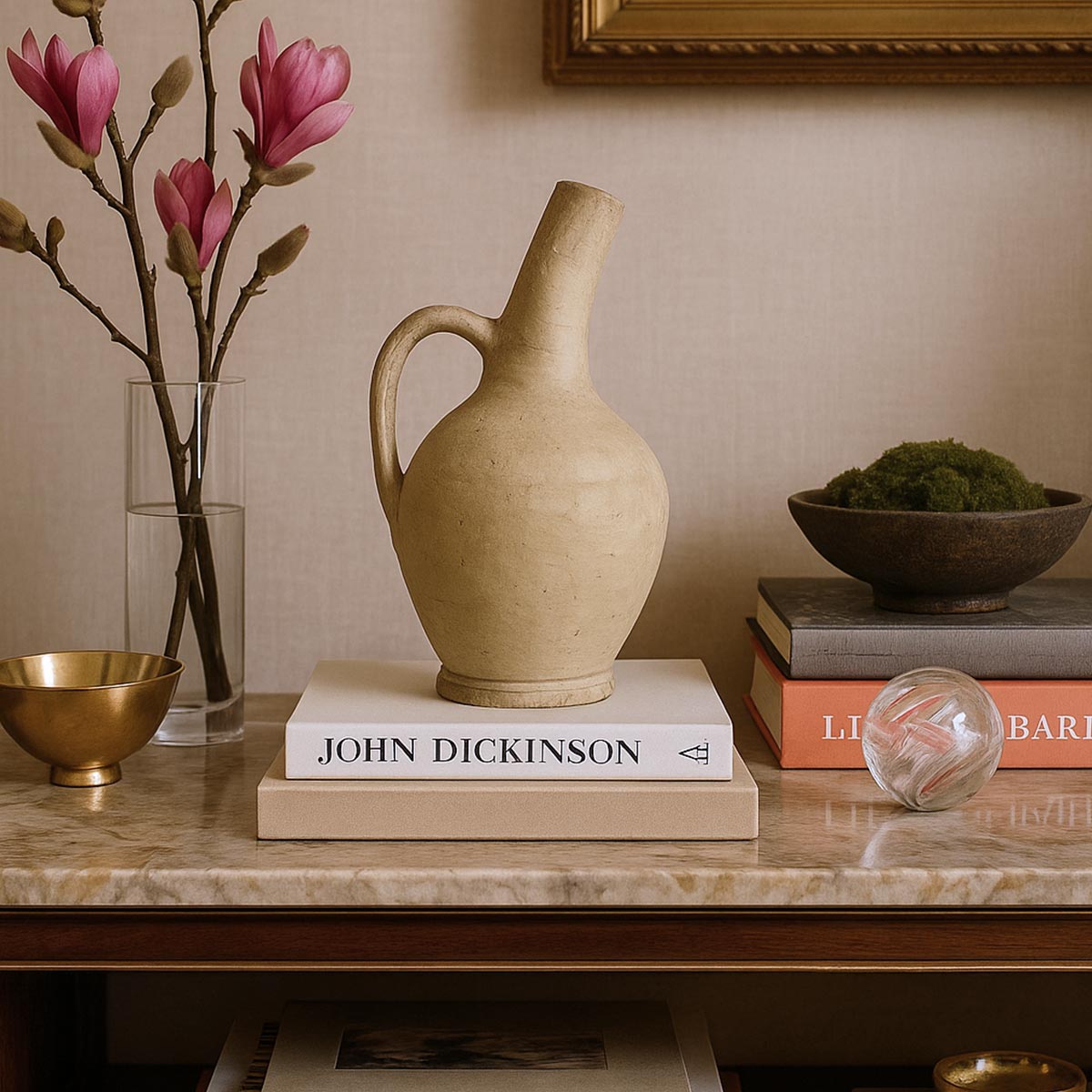
The piece from the journey
Amphora Camarguaise
A decorative terracotta amphora with an essential shape, found in Arles during our trip to the south of France.
Every mark and surface variation contributes to its uniqueness.
The first object of a journey just begun
We left Arles the following morning. In the trunk was already the first find of the trip and, with it, confirmation of why we continue to search: not only to find beautiful objects, but to reconstruct the steps, encounters, and places that brought them to us.
The Amphora Camarguaise thus became part of the Vicode archive: not as a product identified from a catalog, but as a presence encountered along the way.
You can discover other sculptural forms, ceramics, and selected pieces in the collection dedicated to designer and artisanal vases .
Elena & Lorenzo — Vicode

